
Is That Photo Real? How to Tell If an Image Is AI-Generated
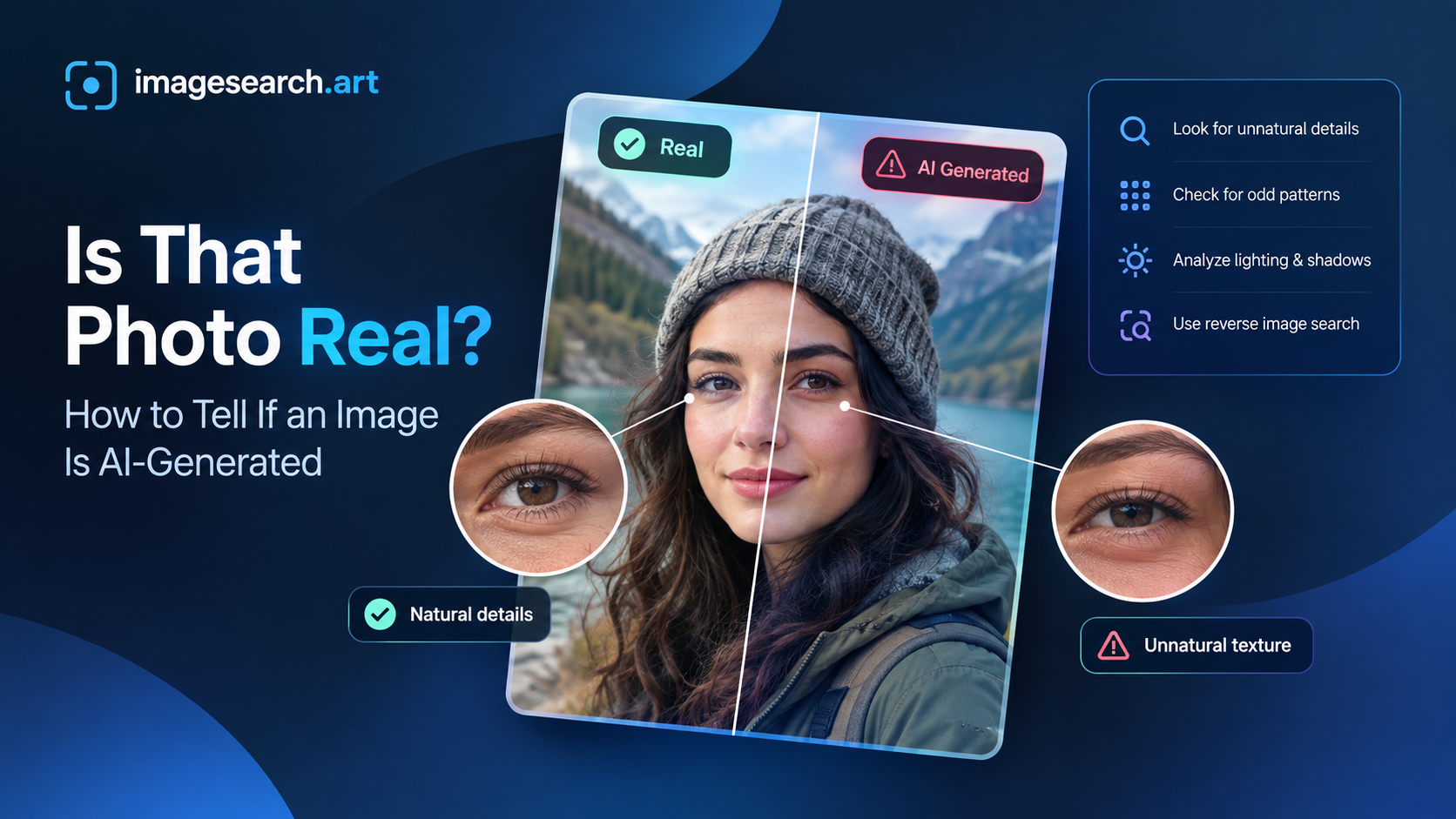
Here's an uncomfortable fact: you're probably worse at spotting AI-generated images than you think. A widely cited 2025 study by the identity-verification firm iProov tested 2,000 consumers on their ability to tell real photos and videos apart from AI-generated ones — and found that only about 1 in 1,000 people could correctly identify every single example. A separate University of Florida study published in early 2026 tested people specifically on still images and found human accuracy sitting right around chance level, essentially a coin flip, while a machine-learning model tested on the same images scored around 97%.
That gap between human intuition and actual accuracy is exactly why "just look closely" is no longer good advice. Here's what actually helps instead.
Why AI-Generated Images Have Become So Hard to Spot
Early AI-generated images had obvious tells — melted hands, nonsensical text, waxy skin, backgrounds that didn't quite make sense. Modern image generators have largely closed those gaps. Open-source and commercial tools have become accessible enough that convincing synthetic images no longer require any technical skill, which is a major reason researchers have tracked such steep growth in AI-generated content across social media, dating platforms, and even news imagery over the past two years.
Researchers studying this "truth bias" phenomenon have found something particularly interesting: people don't just fail to notice fake images — they actively lean toward assuming images are real by default. In some controlled studies, participants misclassified AI-generated faces as genuine more than two-thirds of the time.
Visual Clues That Still Sometimes Give AI Images Away
Detection isn't hopeless — it's just unreliable as a sole method. These are the areas where AI models still tend to slip up, though newer models are closing these gaps quickly:
Hands and fingers
Extra or missing digits, unnatural bends, or fingers that blend into each other remain one of the more common tells, though this is improving fast in newer models.
Text within the image
Signs, labels, and text on clothing often come out garbled or nonsensical.
Ears and teeth
Asymmetry, unnatural spacing, or overly uniform teeth are frequent giveaways.
Background consistency
Look at reflections, shadows, and repeating patterns — AI models sometimes struggle to keep backgrounds logically consistent, especially around the edges of a subject.
Skin texture
Unnaturally smooth or uniformly textured skin, without the small imperfections real photos capture, can be a signal — though this overlaps heavily with normal photo filters and editing, so it's not reliable alone.
Eyes
Mismatched earrings, oddly shaped pupils, or reflections in each eye that don't match are worth a second look.
The key limitation
Independent research has found that even trained evaluators looking specifically for these clues plateau at accuracy rates not far above random guessing on high-quality synthetic images, and performance on video deepfakes is worse than on stills.
Why You Can't Rely on Your Eyes Alone
Multiple independent research groups have converged on a similar conclusion in the past year: human visual detection of AI-generated images clusters in a fairly narrow band, generally somewhere between the high-40s and low-60s percentage range for accuracy, depending on image type and study design — with portraits somewhat easier to evaluate than complex scenes like landscapes or crowded urban photos. For comparison, purpose-built detection algorithms evaluated under the same conditions have scored significantly higher, in some cases in the 96–98% range in controlled tests — though it's worth noting vendor-published accuracy claims should be treated cautiously, since real-world performance on unfamiliar image generators tends to be lower than lab benchmarks suggest.
Tools and Techniques That Actually Help
1. Reverse image search
This won't tell you outright whether a photo is AI-generated, but it answers a related and often more useful question: does this exact image, or a close variant of it, exist anywhere else online? A genuine photo — say, a real product photo, a real person's vacation picture, or a journalist's photograph — usually has a traceable history: earlier posts, the original source, or related images from the same photoshoot. A synthetic image generated for a scam or fake profile typically has no history at all, because it was created moments before being used.
2. Dedicated AI-detection tools
A number of services now specialize in analyzing images for statistical patterns typical of generative models. These tools are more accurate than the human eye but are not infallible — accuracy varies a lot depending on which AI model created the image, and detection tools trained on one generator sometimes miss images from a newer one.
3. Metadata inspection
Some (not all) images retain metadata indicating the software used to create or edit them. This is easy to strip out, so its absence proves nothing, but its presence can be a useful clue.
4. Content provenance labels
A growing number of platforms and camera manufacturers are adopting content credentials — a kind of digital watermark that discloses whether an image was AI-generated or edited. Regulatory pressure is accelerating this: the EU's AI Act, which took effect in mid-2026, now requires certain AI-generated content to carry machine-readable labeling, and several other countries have introduced similar disclosure rules.
Where This Matters Most?
Conclusion
The honest takeaway from the research is humbling: your eyes alone aren't a reliable filter anymore. A quick reverse image search, a look at the available metadata, and a healthy dose of skepticism toward "too perfect" images will serve you better than any amount of squinting at pixels.